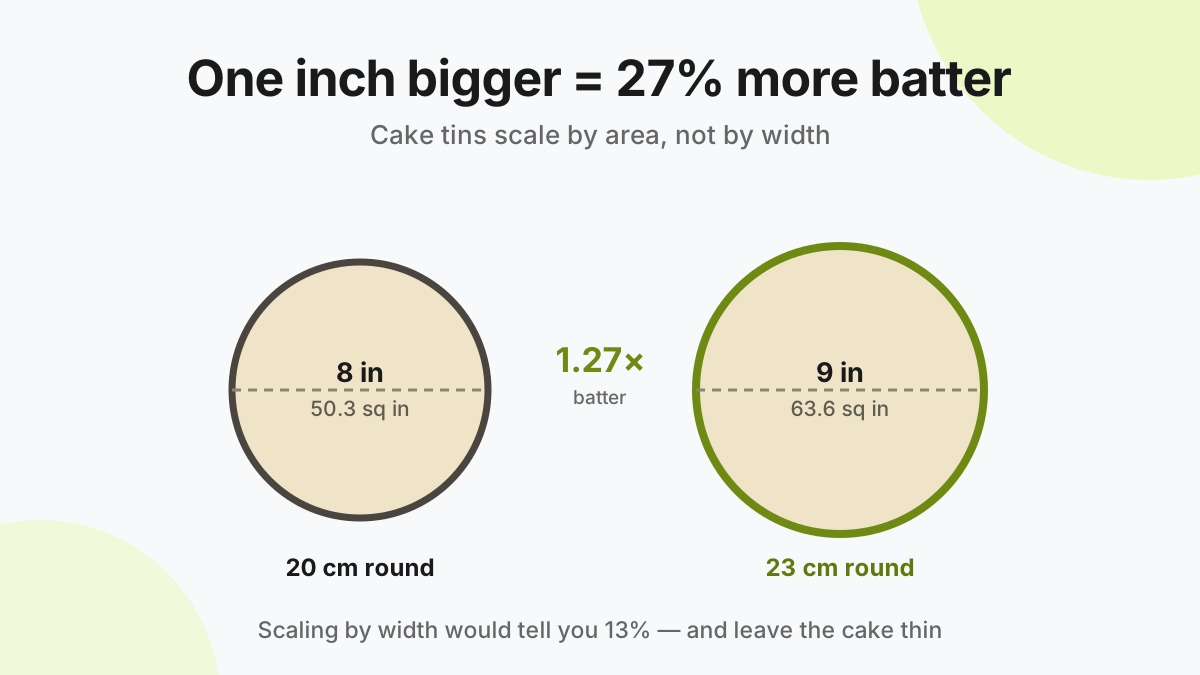
Cake tins scale by area, not width. An 8-inch round holds 50.3 sq in and a 9-inch holds 63.6, so swapping up needs 27% more batter — not the 13% you get by comparing the widths.
This is the single most common baking-substitution mistake, and it is easy to see why. Nine is 12.5% bigger than eight, so 12.5% more batter sounds right. It is not, and a cake baked on that assumption comes out thin, dry at the edges and over-browned.
Below is the arithmetic, a chart for every common tin, and the two rules worth memorising.
Why you scale by area, not width
Batter fills a footprint, and a footprint is two-dimensional. The area of a round tin is:
Area of a round tin
Area = π × (diameter ÷ 2)²
An 8-inch tin: π × 4² = 50.3 sq in
A 9-inch tin: π × 4.5² = 63.6 sq in
Because the radius is squared, a small increase in width produces a much larger increase in area. That is the whole trick:
- Width comparison: 9 ÷ 8 = 1.125, so 13% more — wrong
- Area comparison: 63.6 ÷ 50.3 = 1.27, so 27% more — correct
Scaling by width leaves you about 12% short. In a cake that normally rises to 5 cm, that is roughly a centimetre of missing height, and the thinner batter sets faster than the recipe's timing expects.
Cake tin area and batter multiplier chart
All figures assume the standard 2-inch (5 cm) tin depth. The multiplier column tells you what to multiply the recipe by if it was written for an 8-inch round, the most common starting point.
| Tin | Metric | Area | vs 8″ round |
|---|---|---|---|
| 6″ round | 15 cm | 28.3 sq in | 0.56× |
| 7″ round | 18 cm | 38.5 sq in | 0.77× |
| 8″ round | 20 cm | 50.3 sq in | 1.00× |
| 9″ round | 23 cm | 63.6 sq in | 1.27× |
| 10″ round | 25 cm | 78.5 sq in | 1.56× |
| 12″ round | 30 cm | 113.1 sq in | 2.25× |
| 6″ square | 15 cm | 36.0 sq in | 0.72× |
| 8″ square | 20 cm | 64.0 sq in | 1.27× |
| 9″ square | 23 cm | 81.0 sq in | 1.61× |
| 10″ square | 25 cm | 100.0 sq in | 1.99× |
| 11 × 7″ rectangle | 28 × 18 cm | 77.0 sq in | 1.53× |
| 9 × 13″ rectangle | 23 × 33 cm | 117.0 sq in | 2.33× |
| 8.5 × 4.5″ loaf | 21 × 11 cm | 38.3 sq in | 0.76× |
| 9 × 5″ loaf | 23 × 13 cm | 45.0 sq in | 0.90× |
Round areas are πr²; square and rectangular areas are length × width. Metric sizes are the nearest standard tin, not exact conversions — a 20 cm tin is 7.87″, close enough that the difference is under 3%.
To use a tin that is not on the list, work out both areas and divide. A 9-inch round into a 10-inch round is 78.5 ÷ 63.6 = 1.23, so multiply the recipe by 1.23.
The round-to-square rule: always 27%
A square tin holds 27% more than a round tin of the same nominal size — and it is 27% at every single size, not a coincidence of one measurement.
The reason it is constant is simple algebra. A square of side d has area d². A circle of diameter d has area πd²÷4. Divide one by the other and the d² cancels, leaving 4 ÷ π = 1.273. The size never enters into it.
That gives a second rule worth remembering: a square tin holds roughly the same as a round tin one inch larger. An 8-inch square is 64 sq in and a 9-inch round is 63.6 — within 1% of each other, so you can swap those two with no change to the recipe at all.
What happens to bake time and temperature
Changing the tin changes how deep the batter sits, and depth drives the timing far more than width does.
- Same batter, wider tin → shallower cake. Put an 8-inch recipe into a 9-inch tin without scaling up and the batter sits about 21% shallower. Keep the temperature and start checking 5–10 minutes early.
- Same batter, narrower tin → deeper cake. The outside can brown before the middle sets. Drop the oven by about 15 °C (25 °F) and expect a longer bake.
- Scaled batter, same depth → similar time. If you multiply the recipe correctly, depth stays put and the original timing is close. Check a few minutes early anyway, since a larger mass still takes slightly longer.
Treat these as starting points rather than precise rules — ovens vary, and a skewer in the centre is a better guide than any timer.
Scaling the ingredients once you have the multiplier
The multiplier applies to every ingredient equally. Multiply each weight by the same number and the ratios stay intact.
This is where working in grams pays off. Multiplying 250 g of flour by 1.27 gives 318 g, which you weigh out directly. Multiplying 2 cups by 1.27 gives 2.54 cups, which is 2 cups plus about 8.6 tablespoons — a number nobody wants to measure. If your recipe is in cups, our grams-to-cups converter will turn it into grams first, and the flour converter covers the ingredient that matters most.
Two things do not scale cleanly:
- Eggs. You cannot use 1.27 eggs. Beat the eggs, weigh the total, and take the fraction you need — a large egg is roughly 50 g without the shell.
- Tin preparation. Butter and flour for greasing scale with the surface you are lining, not with the recipe.
One more caution: the multipliers here assume both tins are the same depth. If yours is noticeably deeper or shallower, compare full volumes instead — area × depth — rather than area alone. And if you also need to swap between cup standards, note that a US cup and a metric cup are not the same size.
Got your multiplier? Now scale the weights
Convert the recipe to grams first, multiply, and skip the awkward cup fractions entirely.
Open the converterFrequently asked questions
Yes, but you need 27 percent more batter to get the same depth. An 8 inch round holds 50.3 square inches and a 9 inch round holds 63.6, so the multiplier is 1.27. If you bake the original quantity in the larger tin the cake will be about a fifth shallower and will bake faster.
Because batter fills a two dimensional footprint, not a line. Going from 8 to 9 inches is only 12.5 percent wider, but the area grows by 27 percent because area depends on the radius squared. Scaling by width understates the batter you need by roughly half.
A square tin holds 27 percent more than a round tin of the same nominal size, at every size. The ratio is exactly 4 divided by pi, which is 1.273, because a square of side d has area d squared while a circle of diameter d has area pi times d squared over four.
A 9 inch round. An 8 inch square is 64 square inches and a 9 inch round is 63.6, so they are within 1 percent of each other. As a general rule a square tin holds about the same as a round tin one inch larger.
Only if the depth of the batter changes a lot. A shallower cake in a wider tin bakes faster, so keep the temperature and start checking 5 to 10 minutes early. A deeper cake in a narrower tin can brown before the centre sets, so drop the oven by about 15 degrees Celsius or 25 Fahrenheit and bake longer.
Multiply every ingredient weight by the same number. Weighing in grams makes this simple because you can multiply directly, whereas cup measurements produce awkward fractions. Eggs are the exception since they cannot be split neatly.
Yes. The area multipliers on this page assume both tins are the same depth, which is usually 2 inches for standard cake tins. If your replacement tin is noticeably deeper or shallower, compare the full volume instead by multiplying area by depth.
Usually yes. A 9 by 13 pan is 117 square inches and two 9 inch rounds come to 127 square inches, so the pan holds about 92 percent of the batter. That is close enough to work, though the cake will be slightly deeper and will need longer in the oven.